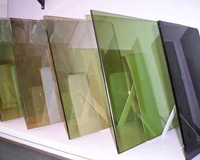
Low emissivity coated glass is also called Low-E glass. Low-E glass is to coat low emissivity silver and metal oxide layers on glass surface. The coatings on glass will show different colors. Its major properties is to lower the U-value and selectively lower the SC which on the whole improves the glass energy efficiency. It features high infrared reflection. It can directly reflect far infrared. Because of its low surface emissivity(E), it absorbs and re-radiates very little energy. It has a wide range of shading coefficient(SC) which can meet different solar control requirements according to different climates. It can be divided into high transmission low-E glass and solar control low-E glass.
High transmission Low-E glass has shading coefficient Sc≥0.5 which does not reduce too much solar heat. It is very suitable to be used in the northern area where heating system is adopted. In winter, sun rays can transmit through this type of Low-E glass into the room and the energy is absorbed by interior objects. The objects in the room will re-rediate far infrared which cannot pass through the Low-E glass. Such solar heat is confined indoors together with the heat from the indoor heaters. Thus, heating costs can be reduced.
Solar Control Low-E glass has shading coefficient Sc<0.5 which can reduce solar heat transmission. It is very suitable to be used in the southern area where air conditioner is used for cooling. In summer, it can block solar heat from entering the room as well as to block scattered far infrared from outdoors. Thus, the costs of air conditioning can be reduced.
According to the structure of Low-E coating, Low-E glass may be classified as single silver Low-E glass, double silver Low-E glass and so on.
Low-E insulating glass, a recognised energy saving building material, is advocated to use in green architecture by the country. It can meet or even out perform the requirements stated in the national standards for energy conservation of materials used in public buildings and residential buildings. The Low-E coating is made by using vacuum magnetron sputtering technology to deposit metallic silver and auxiliary layers on glass surface. It is then assembled with another piece of glass as an insulating glass unit enclosed with dry air. Compare Low-E insulating glass with clear insulating glass, it’s silver layer has high reflection to solar heat. This keeps away solar heat from outdoors while allows good natural lighting indoors in summer. In winter, it prevents indoor heat from getting out of room through the glass so as to conserved building energy. Low-E insulating glass can better preserve energy than monolithic glass upto a saving of 67-70%. It also saves around 40% more energy than clear insulating glass.
- Features
Can be bent and post-tempered after coating.
Has optical properties and energy efficiency as ordinary Low-E glass.
- Specifications
Dimensions of standard sheet (mm): 2440x3660, 2400x3300, 2100x3300
Maximum dimension(mm): 3300x6000
Minimum dimension(mm): 300 x 800
Thickness(mm): 3, 4, 5, 6, 8, 10, 12, 15, 19
The other thicknesses and sizes may be available upon request.
Notes for use
Acoustic and thermal insulation:
Filling argon (Ar) in the Cavity of insulating glass may further lower the U-value, and raise the sound reduction index, Rw.
Prevention of thermal breakage :
When products with solar energy absorbance approaching to or above 70% are selected, it is recommended that the products be tempered or heat-strengthened to prevent breaking due to thermal stress. Selection of color:
The colors listed in the performance data table are outdoor natural reflective colors. When the background color changes, the observed reflective color may also change accordingly, therefore, the products should be observed at different locations from different angles for color selection.
|